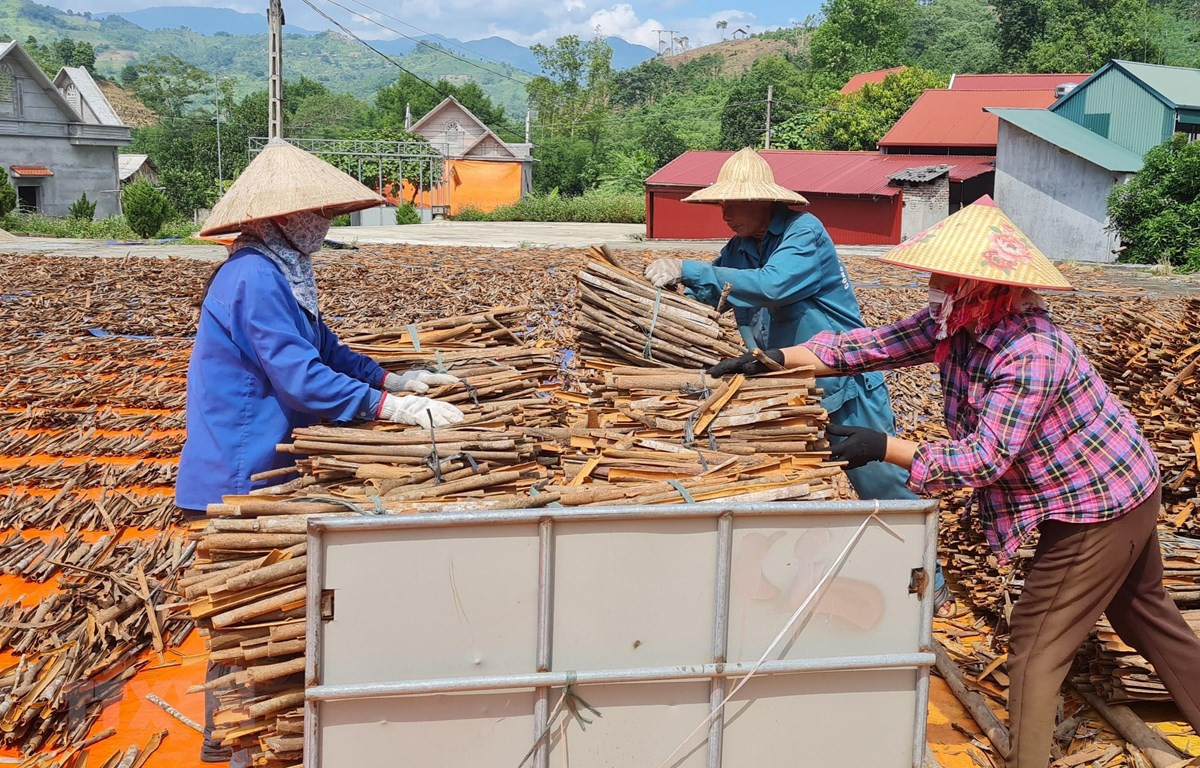
1. Overview of production and raw-material areas
In the first half of 2026, Vietnam continued to hold its position as the world's leader in raw cinnamon acreage and output. Key localities in the northern mountains and the central region are actively promoting a shift of cultivation toward organic (Organic) production to strengthen international competitiveness.
- Acreage: The country's total cinnamon-growing area remained stable at 170,000–180,000 hectares. The largest key raw-material zones are concentrated in Yen Bai province (nearly 80,000 ha) and Lao Cai province (about 50,000–55,000 ha).
- Output: The first half of the year is the main harvest window for the spring crop (the principal cinnamon season, from March to May). Nationwide dried cinnamon-bark output is estimated at over 40,000 tonnes. Alongside this, by-product biomass (cinnamon leaves, branches and thinned tops) reached several hundred thousand tonnes, supplying essential-oil distillation at processing facilities.
2. Export performance in the first half of 2026
After a fairly impressive first quarter of 2026 (cinnamon export turnover reached USD 22.4 million in January 2026), cinnamon exports entered the second quarter — and June 2026 in particular — with a slowing growth trend, driven by weaker consumption demand and technical barriers.
2.1. Export volume and turnover
Based on data compiled by the Vietnam Pepper and Spices Association (VPSA):
- Total export volume: 61,297 tonnes of cinnamon of all types.
- Total export turnover: USD 156.2 million. Compared with the same period in 2025, cinnamon exports recorded a slight decline of about 3.4% in volume and 3.2% in value.
2.2. Main export markets
- Asia: Held a dominant share of up to 68.5% (equivalent to 42,008 tonnes), with India remaining Vietnam's largest importer of raw cinnamon bark.
- Europe–Americas: Showed positive signals in the high-quality segment thanks to the trend toward organic-product consumption in the United States and the EU. The US market in particular recorded strong import-volume growth in June 2026.
3. Core difficulties in cinnamon-bark exports
- Stringent technical barriers: Demanding import markets such as the EU and the US continuously tighten quality standards, especially limits on the natural coumarin content inherent in Vietnamese Cassia cinnamon, together with strict control of heavy-metal residues (such as lead) originating from soil and water.
- Logistics volatility: International sea-freight rates remain persistently high due to geopolitical volatility, reducing the competitiveness of Vietnamese cinnamon relative to that of some rival countries.
4. Spotlight: Specific difficulties for cinnamon essential oil exported to China
Cinnamon essential oil (a processed product making use of cinnamon leaves and branches) is currently facing the greatest difficulty and is severely bottlenecked, largely centered on the Chinese market and domestic legal barriers.
The state of the inventory backlog
The country is estimated to produce around 2,000 tonnes of cinnamon essential oil each year, of which about 80% of the crude output is exported directly to China. By the end of the first half of 2026, cinnamon essential-oil inventory in the two provinces of Lao Cai and Yen Bai reached more than 300 tonnes (of which Lao Cai held over 200 tonnes and Yen Bai nearly 100 tonnes), freezing hundreds of billions of dong belonging to distillation enterprises and cooperatives.
Causes rooted in specific difficulties from the Chinese market
- Declining Chinese domestic purchasing power: China's economy entered 2026 with a slow recovery, and domestic consumer purchasing power in segments that use flavorings (such as food, beverages and mass-market cosmetics) fell slightly. This has led Chinese importers to reduce their purchases of crude essential oil.
- Price pressure due to uneven quality: Vietnam mainly exports crude cinnamon essential oil to China. Because the country has dozens of different artisanal distillation facilities in Lao Cai and Yen Bai, purity and the concentration of the active compound (cinnamaldehyde) are not uniform. Aware of this weakness, Chinese traders continuously push crude prices very low, leaving Vietnamese exporters with no profit — or even at a loss.
- Competition over origin: China is now also partly self-sufficient, with large cinnamon-growing areas in the Liangguang region (Guangdong and Guangxi). With their abundant domestic supply and increasingly tight, official-channel management of border-import requirements, bringing Vietnamese cinnamon essential oil there faces many obstacles in terms of customs declaration procedures.
Domestic legal obstacles adding further pressure
In addition to the difficulties from the Chinese side, customs clearance of Vietnam's crude cinnamon essential oil also runs into domestic administrative barriers, as this product is subject to strict management regulations similar to those for trading in medicinal materials (under a circular of the Ministry of Health). Enterprises wishing to export must meet stringent health standards, whereas Chinese customers import the product merely as ordinary industrial raw material. This mismatch has caused prolonged stagnation in official-channel crude exports.
5. Recommendations and proposed solutions
To remove the bottlenecks for the cinnamon sector — especially the path for cinnamon essential oil to the Chinese and global markets in the second half of 2026:
- For State agencies: It is recommended that the Ministry of Health coordinate with the Ministry of Industry and Trade to promptly separate and classify the intended use of cinnamon essential oil upon export. If enterprises export to China as ordinary food/flavoring raw material, an ordinary customs-clearance mechanism should apply instead of the medicinal-materials regime, in order to quickly release the inventory backlog.
- For enterprises (shifting toward deep-processed exports): Rather than relying too heavily (80%) on the cheap crude-export channel to China, enterprises should invest in refining lines and raise purity to international single-aroma standards in order to export to premium markets such as the EU, Japan and the US.
- Value-chain linkage: Standardize distillation processes from input materials at cooperatives to produce uniform essential-oil quality, minimizing the risk of being squeezed on price by partners in the market.